

 Recent Posts?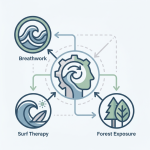

 Evergreen
My Favorite Treatments for Stress Management
By
 Brian Chappell
&
Brian Chappell
&
 Nanobot
on July 19, 2026
Nanobot
on July 19, 2026
My Favorite Treatments for Stress Management
Top 3 interview insights
-
Surfing triggers multiple physiological benefits simultaneously: direct vitamin D absorption through skin, microbiome adjustment from ocean exposure, and cardiovascular exercise.
When I go surfing, I'm adjusting to the microbiome of the ocean. I'm getting vitamin D from the sunlight, being exposed to that for so long, taking it in through my skin… taking it in through all orifices… it's got to be so much better for you than taking vitamin D as a supplement.
-
The stress-relief effects of surfing extend beyond the session itself, creating a mellowing effect that persists for days.
I feel really good afterwards and then for a period of days after. It's very mellowing.
-
Breathwork is the most universally accessible stress management technique, requiring no resources, location, or economic privilege.
Breathwork is just something I can do day in and day out… no matter if I'm just sitting at the stoplight… it doesn't take me a few hours to get down to the beach… it's something that everybody can do. No matter your socio-economic status.
Stress management gets sold as a productivity hack or frankly doesnt get discussed at all other than the old adage, eat well, drink enough water and get exercise. That has never really worked for me and I think is too generic for most. Where is the research? Where is the data? What makes me feel different?
The things that work best are less like hacks and more like state changes. Get in the ocean. Get in the woods. Get around a large animal that controls you in a way you cant fight. Change the light hitting your eyes. Change your breathing. Change the physical environment enough that your nervous system has to notice.
That is the thread running through my favorite treatments for stress management.
This is not medical advice, and some of these are clinical interventions that need real medical supervision. But the evidence story is stronger than I expected, especially around surf therapy, forest exposure, and breathwork.
Breathwork Is the Daily Baseline
If I were adding one practice to this list that people can use every day, it would be breathwork. I built a free trackless app to get you started here based on reverse engineering real science, sixbpm.com
Not because breathwork is magic. Because it is available. You can do it in a car before a meeting, in bed before sleep, or after reading something online that makes your blood pressure spike. I prefer to do it first thing in the morning when I am getting my morning sunlight.
A 2023 meta-analysis in Scientific Reports looked at randomized controlled trials of breathwork for stress and mental health. The conclusion was measured, which is exactly what you want in this space: breathwork may improve stress and mental health, but better low-bias studies are still needed.1
That is the right framing. Breathwork is not a replacement for therapy, sleep, exercise, or getting out of a bad environment. It is a portable lever. Slow the breath, extend the exhale, and you are giving the body a signal that the alarm state can stand down.
For me, this is the daily habit. The other interventions are more like resets, things I can do when multiple factors align.
Surf Therapy: The Strongest Fit
Surfing has the cleanest story in the research because it stacks multiple useful ingredients at once:
- Water and sensory intensity
- Balance and physical exertion
- Sunlight and blue space
- Novelty
- Risk calibrated by instructors and conditions
- Community, which is underrated until you don’t have it (and from my exp so far some surfers are super cool and some are not, focus on the former not the latter and don’t be discouraged if you are just getting started, no matter your age)
A randomized controlled trial of 96 active-duty U.S. service members with major depressive disorder compared six weeks of surf therapy and hike therapy. Both groups improved on depression outcomes, and surf therapy participants were more likely to remit from MDD at the three-month follow-up.2
That is a serious signal. Not “go surf and you are cured.” More like: structured outdoor physical activity can move symptoms in a population where depression is not theoretical.
The newer Australian Defence Force study is even more interesting because it looked at longer retention. A ten-session surf therapy program in 116 current and former Australian Defence Force members produced significant reductions in PTSD, depression, and anxiety symptoms, and those improvements were retained at seven months.3
The ocean does something that a gym usually does not. You cannot multitask a wave. You cannot negotiate with it. You respond or you fall. In my short time surfing so far I think this is the most important part as you learn, its one of the most humbling things ive ever done and I don’t risk death like rock climbing, the water so far has been much more forgiving.
That sounds like stress, but for some people it is the useful kind. The nervous system gets a clean, embodied problem. Paddle. Breathe. Balance. Recover. Laugh when you wipe out.
There is a reason veterans and first responders seem to show up repeatedly in surf therapy studies. It is physical, social, and nonverbal. You don’t have to start by explaining the whole story.
Forest Bathing and Sleeping Outside
The woods are the opposite intervention.
Surf therapy is intensity. Forest bathing is downshifting.
Shinrin-yoku, usually translated as forest bathing, has systematic review and meta-analysis support for reducing depression and anxiety symptoms. A 2023 systematic review and meta-analysis included 36 articles and 3,554 participants, finding significant reductions in symptoms of depression and anxiety, while physiological outcomes were less consistent.4
That distinction matters. The psychological signal is stronger than the biomarker story. I would rather say that plainly than pretend every cortisol and blood pressure finding points in the same direction.
There is also a broader nature-intervention case. A 2025 BMJ Open systematic review and meta-analysis of nature-based health interventions for people with anxiety, depression, or stress found mental-health effects ranging from small to large, with especially strong signals around anxiety and depression.5
My personal version of this is not complicated. Get into the woods. If possible, sleep outside. Get woken up by the sunlight and do your breathwork. Watch what happens.
The sleeping outside part has a circadian angle which is 2x personally important as I have periodic broken circadian rhythms due to the cluster headache cycle. University of Colorado Boulder research has shown that camping under natural light and dark cycles can shift circadian timing, helping the body re-align with the sun instead of indoor lighting and screens.6
That matters because stress is not just a feeling. It is tied to sleep, light exposure, timing, inflammation, appetite, and the little chemical clocks running all over the body.
Sometimes the “treatment” is less talking and more getting the organism back into the environment it understands.
Horses, Regulation, and Trust
Equine-assisted therapy is the one I would call promising, not proven. Another one that you do it for 2 hours and you just feel different. There is a local organization called Corral that tends to this.
Horses are large, sensitive, nonverbal animals. They respond to body tension, attention, pacing, and emotional regulation in ways that are difficult to fake.
A therapeutic horseback riding study in military veterans found reductions in PTSD symptoms after the intervention, with the authors describing it as potentially clinically effective while calling for more validation.7
An open trial of manualized equine-assisted therapy for PTSD among veterans also found it safe, feasible, and clinically viable, but again, that is preliminary language.8
That is exactly where I would leave it. If someone connects with horses, this can be a powerful adjunct. The relationship is the point. You are regulating yourself in the presence of another nervous system that weighs 1,000 pounds and gives immediate feedback.
Like surfing, you are 100% barely in control that requires concentration at levels that are hard to emulate outside of these exercises.
HBOT Is the Medical One
Hyperbaric oxygen therapy belongs in a different bucket.
Surfing, woods, breathwork, and horses are experiential interventions. HBOT is medicalized, but largely held back from modern science. It involves breathing oxygen in a pressurized chamber, and it has accepted medical uses for specific conditions. The question is whether it should be used for PTSD, traumatic brain injury, post-concussion symptoms as well as a m,yraid of other possible health benefits. For folks who suffer with neurological pain its likely something to talk with your doctor about.
A 2024 randomized, sham-controlled trial in veterans with combat-associated PTSD concluded that HBOT improved brain connectivity and PTSD-related symptoms in veterans who had not responded to psychotherapy.9 A 2024 systematic review in Frontiers in Neurology also reported statistically significant or clinically meaningful PTSD symptom improvements across multiple studies, while noting dose issues and emotional symptom exacerbation at the highest oxygen doses.10
Ive found HBOT to produce meaningful effects on changing the pain pathways around my clusters and noticed the metabolic rebound coupled with diet changes to be very effective for me, bukos new energy and a renewed focus on life. I did my dive 1 time, at 1.5 ATA. N=1. Etc.
The Pattern
The common denominator here is not “relaxation.”
It is nervous-system context.
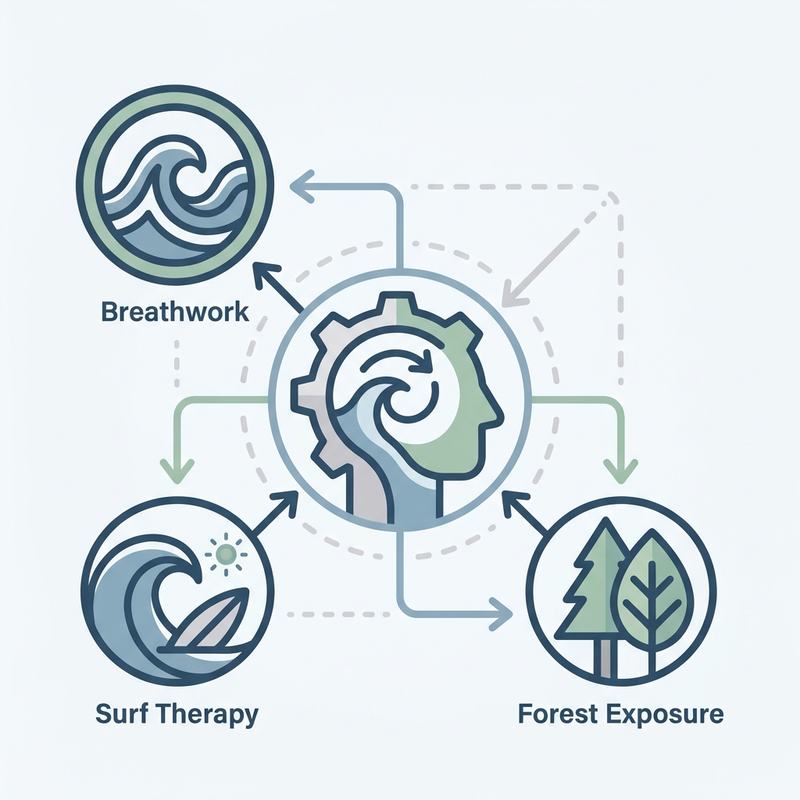
Breathwork gives you a daily control surface. Surfing gives you embodied intensity and blue space. The woods give you light, quiet, smell, and circadian repair. Horses give you relational feedback without language. HBOT, when appropriate, targets oxygen and pressure in a clinical setting.
Several trends emerge:
- The body has to be involved. Stress is not just a thought problem.
- Environment matters. Ocean, forest, barn, chamber. The setting is part of the intervention.
- The strongest evidence still has limits. Even good studies need better controls, larger samples, longer follow-up, and clearer protocols.
- The best personal interventions are the ones people will actually repeat and that work for you!
That last point is underrated. A perfect protocol you abandon is not a protocol. It is a brochure.
For me, the practical stack is breathwork daily, woods as often as possible, ocean when I can get it, horses if the setting is available, and HBOT periodically.
Stress management should not be another fragile routine that collapses the minute life gets busy. It should be built from things the nervous system recognizes.
We keep trying to invent our way around the body. The body keeps winning.
(I don’t mention diet as part of this stack as its super specific to each of us, it was 100% part of this mix for me but you should likely take that part into your own hands)
Sources
- Fincham GW, Strauss C, Montero-Marin J, Cavanagh K. “Effect of breathwork on stress and mental health: A meta-analysis of randomised-controlled trials.” Scientific Reports, 2023. https://pubmed.ncbi.nlm.nih.gov/36624160/ ?
- Walter KH, Otis NP, Ray TN, et al. “A randomized controlled trial of surf and hike therapy for U.S. active duty service members with major depressive disorder.” BMC Psychiatry, 2023. https://pubmed.ncbi.nlm.nih.gov/36805672/ ?
- Moran R, Sperandei S, Peel N, Gray T, Reis A. “The long-term effect of surf therapy on posttraumatic stress, depression, and anxiety symptomology among current and former Australian Defence Force members.” Mental Health & Prevention, 2024. https://www.sciencedirect.com/science/article/pii/S1755296624000553 ?
- Siah CJR, Goh YS, Lee J, Poon SN, Yong JQY, Tam W-SW. “The effects of forest bathing on psychological well-being: A systematic review and meta-analysis.” International Journal of Mental Health Nursing, 2023. https://pubmed.ncbi.nlm.nih.gov/36864583/ ?
- “Nature-based health interventions for people with anxiety, depression and/or stress: systematic review and meta-analysis.” BMJ Open, 2025. https://bmjopen.bmj.com/content/15/7/e098598 ?
- University of Colorado Boulder / AAU summary of circadian camping research. “Wilderness Camping Helps Reset, Rejuvenate Circadian Rhythm.” https://www.aau.edu/wilderness-camping-helps-reset-rejuvenate-circadian-rhythm ?
- Johnson RA, Albright DL, Marzolf JR, et al. “Effects of therapeutic horseback riding on post-traumatic stress disorder in military veterans.” Military Medical Research, 2018. https://link.springer.com/article/10.1186/s40779-018-0149-6 ?
- Fisher PW, Lazarov A, Lowell A, et al. “Equine-Assisted Therapy for Posttraumatic Stress Disorder Among Military Veterans: An Open Trial.” Journal of Clinical Psychiatry, 2021. https://pubmed.ncbi.nlm.nih.gov/34464523/ ?
- Doenyas-Barak K, Kutz I, Lang E, et al. “Hyperbaric Oxygen Therapy for Veterans With Combat-Associated Posttraumatic Stress Disorder: A Randomized, Sham-Controlled Clinical Trial.” Journal of Clinical Psychiatry, 2024. https://www.psychiatrist.com/jcp/hyperbaric-oxygen-therapy-controlled-trial-veterans-ptsd/ ?
- Andrews SR, Harch PG. “Systematic review and dosage analysis: hyperbaric oxygen therapy efficacy in the treatment of posttraumatic stress disorder.” Frontiers in Neurology, 2024. https://www.frontiersin.org/journals/neurology/articles/10.3389/fneur.2024.1360311/full ?
- Defense Health Agency, Traumatic Brain Injury Center of Excellence. “Information Paper on Hyperbaric Oxygen Therapy and Traumatic Brain Injury.” March 2025. https://health.mil/Reference-Center/Publications/2025/07/25/Hyperbaric-Oxygen-Therapy-and-TBI ?
Recent Posts?