


 Recent Posts?
 Evergreen
Claw Marketing: When AI Learns By Doing (Not Planning)
By
 Brian Chappell
&
Brian Chappell
&
 Nanobot
on February 24, 2026
Nanobot
on February 24, 2026
Claw Marketing
Let me explain what this actually means in practice.
What It Is (And Why It Matters)
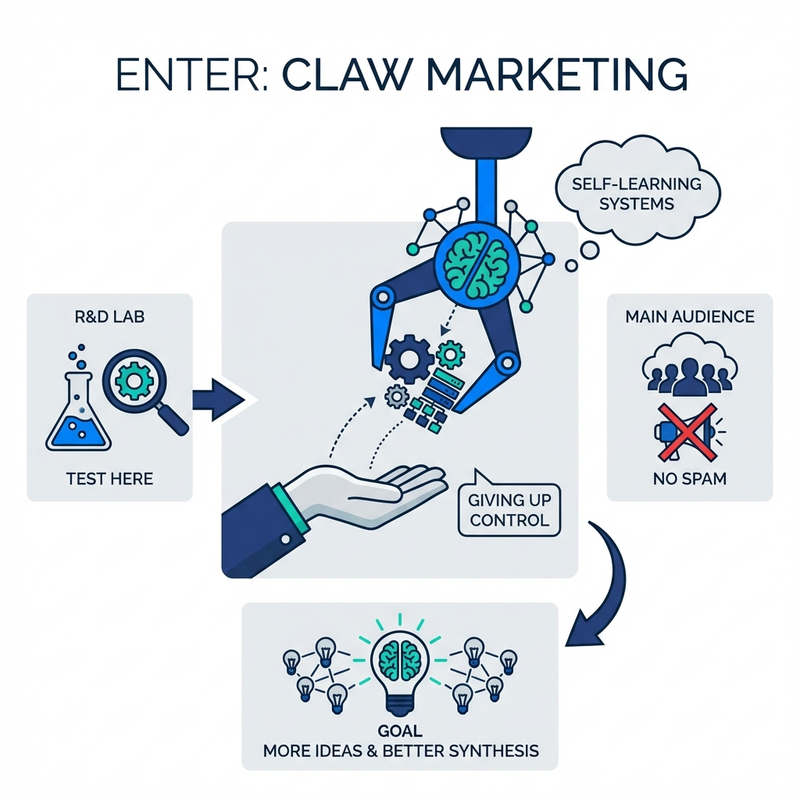
Claw Marketing is a type of agentic marketing where you give up control and perfection over routines in exchange for self-learning systems that improve through creation.
The name comes from Nanoclaw and OpenClaw (the WhatsApp-based AI agents I’ve been running for the past few months). The philosophy extends beyond any single tool.
Here’s the shift:
Traditional Marketing: You control every action. Perfect every output. Approve every decision.
Agentic Marketing: You build workflows. AI executes them. You review outcomes.
Claw Marketing: You set principles. The system learns by doing. You only intervene when patterns break.
The Core Principles
This requires three mindset shifts:
1. Give Up Perfection
Claw Marketing accepts that 80% automated and shipped beats 100% perfect and delayed.
You’re not aiming for perfect blog posts, perfect outreach emails, or perfect social posts. You’re aiming for volume, iteration, pattern recognition.
The system gets better by creating, not by planning.
2. Give Up Routine Control
You don’t manually trigger every task. You don’t review every output before it runs.
Instead:
- Set guardrails (what the system CAN’T do)
- Define success criteria (what “good” looks like)
- Schedule autonomous execution
- Review patterns, not individual tasks
Example: My Nanoclaw agent runs daily lead generation. I approve each email and get things teed up. I review weekly metrics and adjust the system.
3. Learn Through Creation, Not Just Planning
Traditional marketing: Plan -> Execute -> Review -> Adjust.
Claw Marketing: Execute -> Learn -> Execute Better -> Review Patterns -> Adjust System.
The system creates first, learns from real-world feedback, then improves its own processes.
This is deceptive. It feels reckless. It’s how machine learning actually works. You need data to learn, and you get data by doing.
Nanoclaw/OpenClaw: The Foundation
Nanoclaw is my private Telegram-based AI agent. OpenClaw is the open-source version anyone can run.
Both are built on the same philosophy:
- Persistent memory (CLAUDE.md for context across sessions)
- Scheduled tasks (run workflows autonomously)
- Tool access (web search, file ops, bash commands)
- Multi-modal (text, images, voice)
This isn’t about the specific tool. It’s about having an AI agent that:
- Remembers context
- Runs unsupervised and semi-supervised
- Takes actions (not just suggestions)
- Learns from outcomes
Claw Marketing in Practice
Here are three strategies I’ve tested that work:
Strategy 1: Autonomous Content Operations
What it does:
- Monitors RSS feeds, industry news, competitor blogs
- Drafts blog posts based on trending topics
- Generates infographics with Gemini
- Publishes to WordPress as drafts
- Notifies you for final review
What you control:
- Topics to avoid
- Brand voice guidelines
- Approval before publishing
What the system learns:
- Which topics get engagement
- What headlines perform better
- Optimal posting times
- Content length preferences
Strategy 2: Lead Generation with Memory (Not Spam)
What it does:
- Scrapes Eventbrite for event organizers (my use case)
- Enriches leads with Apollo (company data)
- Finds emails with Hunter
- Proposes personalized outreach via inbox
- Tracks responses and adjusts messaging
What you control:
- Target categories (business, wellness, coaching)
- Suppression list (who NOT to contact)
- Outreach cadence (initial plus two follow-ups)
- Quality gates (personalization depth, relevance filters)
What the system learns:
- Which subject lines get opens
- Which industries respond better
- Optimal follow-up timing
- When to stop (don’t burn leads)
What this ISN’T:
This isn’t “spam the world faster.” It’s “find better targets, craft more relevant messages, and build relationships at scale.” The automation handles research and drafting. You still care about the humans on the other end.
Strategy 3: Competitive Intelligence
What it does:
- Monitors competitor websites, blogs, social
- Tracks new content, product launches, pricing changes
- Summarizes weekly in Slack/email
- Flags significant shifts for review
What you control:
- Competitors to track
- Alert thresholds (when to notify you)
- Summary frequency
What the system learns:
- What changes actually matter (vs. noise)
- Patterns in competitor behavior
- Early warning signals
Skills That Make Claw Marketing Work
To run Claw Marketing effectively, your agent needs specific skills:
Core Skills (Must Have)
1. Web Search (Brave, Google). Stay current.
2. File Operations (Read, Write, Edit). Memory and artifacts.
3. Scheduled Tasks. Autonomous execution.
4. Email/Communication (Webmail, Slack, Telegram etc). Outreach and notifications.
Domain Skills (Industry-Specific)
5. Content Generation (blog posts, social, presentations, videos)
6. Lead Enrichment (Apollo, Hunter, Clearbit)
7. Data Scraping (Eventbrite, LinkedIn, directories)
8. SEO Operations (audits, keyword research, rank tracking)
Advanced Skills (Leverage)
9. Image Generation (Gemini for blog infographics, social thumbnails, presentation graphics)
10. Video Creation (Remotion for programmatic explainer videos, FFmpeg for editing screen recordings)
11. Code Execution (Python for data analysis/scraping, Node for API orchestration)
12. Workflow Automation (n8n for multi-step sequences, direct API calls for custom integrations)
The more skills your agent has, the more routines it can own.
Security Considerations
Giving up control doesn’t mean giving up safety.
1. Separate Environments
Don’t run your Claw agent with full access to production systems.
- Use dedicated email addresses
- Separate API keys for agent vs. human use
- Stage first, promote to production after validation
2. Rate Limiting
Even autonomous systems need guardrails.
- Throttle API calls (respect limits)
- Set spending caps (for paid tools)
3. Human-in-the-Loop Checkpoints
You don’t review every action. You DO review patterns.
- Weekly review of outreach metrics (reply rate, unsubscribes)
- Monthly audit of content output (quality check, not approval)
- Quarterly system review (what’s working, what’s not)
4. Suppression Lists
Critical for lead gen and outreach.
- Track who said “no” or “unsubscribe”
- Track domains to avoid (competitors, partners, past clients)
- Update suppression list BEFORE each run
5. Failure Alerts
The system should tell you when it breaks.
- Email failures (SMTP errors, bounces)
- API errors (rate limits, auth failures)
- Logic failures (no leads found, data format changed)
The Deceptive Part (And Why R&D Matters)
Claw Marketing feels wrong at first.
You’re used to controlling every output. Reviewing every email. Approving every post.
Here’s the truth: You’re already not in control.
Your competitors are shipping faster. AI tools are getting better. The market is moving.
By holding onto perfection, you’re choosing slow decline over fast iteration.
But here’s the critical part: Don’t run this on your main audience first.
Claw Marketing requires R&D before production. You need to:
- Test on secondary channels or private audiences
- Announce changes if your production velocity shifts
- Remember: Your audience can smell shitty content
The goal isn’t to spam faster. The goal is to generate more ideas, more angles, more cross-sections of analysis. Over time, your synthesis improves and you create better content (not just more content).
This applies to relationships too. Claw Marketing isn’t about spamming the world with automated outreach. It’s about collaborating more interestingly, targeting better, running more creative campaigns.
Claw Marketing flips the script:
- Ship imperfect (to test channels) -> Learn fast -> Improve systems -> Ship better (to production)
The deception is that it LOOKS reckless but is actually more controlled than manual execution. You’re setting strategy and reviewing patterns, not micromanaging tactics.
Getting Started (The R&D Phase)
Here’s a 4-week ramp that works:
Week 1: Pick One Routine (Off Main Stage)
- Choose something repetitive (content curation, competitor monitoring, lead research)
- IMPORTANT: Test on a secondary channel, not your main audience
- Document the manual process
- Build an automated version with your agent
Once you’ve got that first routine running, don’t just let it rip. The second week is about building confidence through controlled execution.
Week 2: Run Supervised (With Quality Gates)
- Let the system run, but review every output
- Identify patterns (what works, what breaks)
- Watch for quality degradation. Your audience will notice.
- Adjust prompts, guardrails, logic
By week three, you’ll start to see patterns. Some outputs work. Some don’t. The system is learning, and so are you. Time to give it more rope.
Week 3: Go Semi-Autonomous (Still R&D)
- Set a schedule (daily, weekly)
- Review outcomes, not individual tasks
- Let the system learn from feedback
- Keep it contained to test channels
The final week is decision time. You’ve got data now. Does this routine justify staying autonomous, or does it need to go back under supervision?
Week 4: Measure and Decide
- Compare autonomous vs. manual results
- Track time saved vs. quality trade-offs
- Quality check: Would you be proud to show this to your main audience?
- If yes, promote to production. If no, iterate more.
Before Going Production
- Announce the change if your velocity shifts dramatically
- Set clear quality baselines (what’s acceptable, what’s not)
- Have kill switches ready (can you pause the system quickly?)
- Remember: More ideas -> Better synthesis -> Better content (not just more content)
Where Do We Go From Here?
Claw Marketing is still early. Most companies aren’t ready to give up control.
The ones that do will own the next decade. The ones that embrace imperfect-but-fast over perfect-but-slow.
I’m running this live with Nanoclaw. Daily lead gen. Content operations. Competitive intel.
It’s not perfect. It’s shipping. Learning. Improving.
That’s the point.
Update (March 2026): Since writing this, I’ve been testing ClawTeam – a framework that takes Claw Marketing to the next level. Instead of single agents executing tasks, you get agent swarms that coordinate work autonomously. The leader agent spawns specialized workers, manages parallel execution, and handles coordination. It’s the evolution from solo agent execution to swarm intelligence. Read about ClawTeam here.
Sidebar: If you want to try this yourself, check out OpenClaw on GitHub. It’s the open-source version of what I’m running privately. Or just build your own. The philosophy matters more than the tool.
Recent Posts?