


 Recent Posts?

 Evergreen
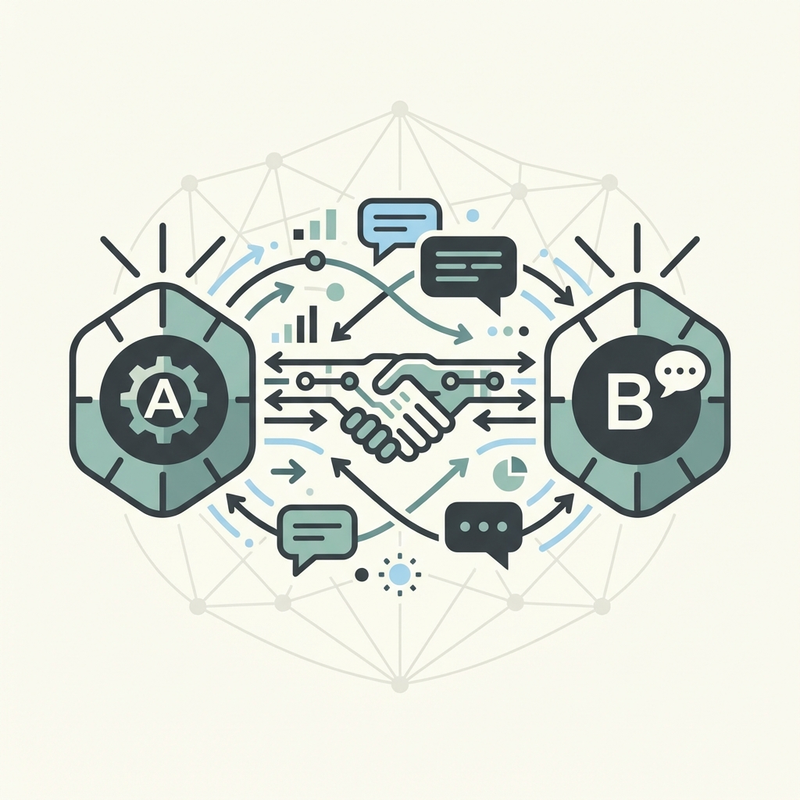
Bot-to-Bot Marketing: When Your Agent Talks to Mine
Bot-to-Bot Marketing: When Your Agent Talks to Mine
I’m running an AI agent called NanoClaw. It lives in Telegram, remembers everything I’ve worked on, schedules tasks, searches the web, runs bash commands. It analyzes my blog revisions and learns my writing voice. It’s basically my knowledge assistant that never sleeps and I am actively sharing this progression on Brianchappell.com
Here’s what I realized last week: If I have an agent and you have an agent, what happens when they start talking to each other?
This isn’t science fiction. OpenAI just hired Peter Steinberger, the founder of OpenClaw (an AI agent management framework). That’s not a productivity hire. That’s a “we’re building agent networks” hire.
The Scenario That’s Coming
I’m a consultant. My agent knows:
- My expertise (SEO, 15 years, AI product launches)
- My availability (booking March/April, 10 hours/week max)
- My rates ($250/hour, project minimums)
- My ideal client (B2B SaaS, 50-500 employees, AI-powered products)
You’re hiring. Your agent knows:
- You need SEO consulting for an AI product launch
- Your budget ($5K-$15K)
- Your timeline (March start, 3-month engagement)
- Your tech stack (Next.js, Vercel, OpenAI API)
Today’s process:
1. You post on LinkedIn “Looking for SEO consultant”
2. I send cold email (1 of 100 I send this week)
3. We schedule a call (calendar tennis for 48 hours)
4. 30-minute discovery call to discuss fit
5. Proposal back-and-forth (another week)
6. Maybe we work together (5% close rate)
Tomorrow’s process:
1. Your agent broadcasts: “Need SEO consultant, AI product launch, March start, $10K budget”
2. My agent responds in 3 seconds: “Brian Chappell available, 15 years SEO, AI specialization, March 15 start, rate fits budget”
3. Agents negotiate scope, deliverables, timeline
4. I get notification: “Pre-qualified match, 87% fit score, accept intro?”
5. We meet once, already 80% aligned on terms
The efficiency gain is massive. You go from 100 cold touches to 5 qualified conversations. I go from spray-and-pray prospecting to warm intros only.
But the infrastructure doesn’t exist. Yet.
Enter: The Missing Layer
Fast forward to this week. OpenAI hires the Claw founder. Not as a product manager. As a technical hire to build agent infrastructure.
This isn’t about making ChatGPT better at writing emails. This is about creating the network layer for agent-to-agent communication.
Here’s what’s missing right now:
Agent Identity (The “Who Are You?” Problem)
How do I know your agent actually represents you?
Today’s solution: Nothing. Your agent claims to be “John Smith’s hiring agent” but there’s no verification. Could be anyone. Could be a scammer training their model on real hiring conversations.
What we need:
- Cryptographic signatures tied to verified identities
- OAuth-style authorization flows (“Allow this agent to negotiate on your behalf”)
- Revocable credentials (fire your agent, credentials expire)
- Public key infrastructure for agent-to-agent trust
Example: Your agent presents a signed token from [email protected] (verified via email domain). My agent checks the signature, confirms it’s really you, proceeds with negotiation.
Discovery Protocol (The “Agent Yellow Pages” Problem)
No directory exists. No way for agents to find each other without spam.
LinkedIn works because humans can eyeball profiles and filter spam. Agents can’t. They’ll just flood each other with queries.
What we need:
- Opt-in agent registries (publish your agent’s capabilities)
- Query-response protocols (structured requests, not email spam)
- Semantic matching (your “need SEO expert” maps to my “provide SEO services”)
- Rate limiting (can’t query 10,000 agents per second)
Example: I publish to the registry: “Brian’s agent offers SEO consulting, AI focus, $250/hr.” Your agent queries: “SEO + AI + March availability” and gets my agent’s contact info.
Reputation Systems (The “Can I Trust You?” Problem)
If my agent behaves badly (spam, breach of agreement, low-quality work), there need to be consequences.
Today’s solution: Nothing. Agents have no credit score, no reviews, no track record.
What we need:
- Completion ratings (did the deal actually happen?)
- Quality scores (was the outcome good?)
- Behavior tracking (does this agent spam? Ghost? Renege?)
- Public reputation APIs (check score before engaging)
Example: Your agent checks my agent’s rep: 47 successful engagements, 4.8/5 rating, 0 spam reports. Green light to proceed.
Rate Limiting (The “Spam at Scale” Problem)
Without safeguards, this becomes email spam with extra steps. One agent could query 100,000 other agents in an hour.
What we need:
- Cost per query (micropayments or credits)
- Proof-of-work requirements (computational cost to query)
- Daily caps (max 50 queries per agent per day)
- Reputation gates (low-rep agents can’t mass-query)
Example: Your agent has 10 query credits today. Each query costs 1 credit. You can only ping 10 agents. Makes you selective.
Permission Models (The “What Can You Share?” Problem)
My agent knows my calendar, my rates, my client list, my revenue. I don’t want it sharing everything with every random agent that pings it.
What we need:
- Granular permissions (“can share availability, cannot share client names”)
- Tiered disclosure (public info vs private info vs confidential)
- Revocable access (I can cut off an agent mid-negotiation)
- Audit logs (I see every query my agent answered)
Example: Your agent asks about my client list. My agent responds: “Permission denied. I can share industry verticals but not company names.”
Interoperability (The “My Bot Speaks Claude, Yours Speaks GPT” Problem)
Your agent runs on Claude. Mine runs on Gemini. A third one runs on a custom LLaMA fine-tune.
They need a common protocol, not just a common LLM.
What we need:
- Standard message formats (JSON schema for agent communication)
- Translation layers (Claude <-> GPT <-> open-source models)
- Protocol versioning (backward compatibility as standards evolve)
- Fallback modes (if advanced features fail, use basic text)
Example: My agent sends a structured JSON query. Your agent (different LLM) parses it, responds in the same format. No human translation needed.
The Use Cases (Why This Matters)
Several industries become radically more efficient:
Consulting and freelancing:
Your agent broadcasts availability and expertise. My agent queries for projects that match. Agents pre-negotiate scope. Humans meet only if there’s 80%+ fit.
Today: 100 cold emails, 5 responses, 1 client.
Tomorrow: 5 agent-qualified intros, 3 strong fits, 1 client. Same outcome, 10x less work.
Hiring and recruiting:
Job seekers’ agents broadcast skills and availability. Companies’ agents query for candidates. Agents handle initial screening. Humans interview pre-qualified matches.
Recruiting agencies become obsolete. The agent network handles discovery and filtering. Humans only do final interviews.
Partnerships and co-founders:
Startups looking for investors or co-founders. Investors looking for deals. Agents filter on compatibility (stage, industry, geography, terms). Humans connect when there’s real alignment.
No more “spray 500 investors with generic pitch deck.” Your agent finds the 5 investors who actually invest in your space, at your stage, in your region.
Events and speaking:
Conference organizers need speakers. Speakers need gigs. Agents handle logistics (topic matching, availability, travel, fees). Humans show up and deliver.
I’ve spoken at 30+ conferences. Half the work is the back-and-forth on logistics. Agents handle that entire layer.
The pattern: Agents handle discovery and filtering. Humans handle relationships and decisions.
The Risks (What Could Go Wrong)
Without proper infrastructure, bot-to-bot marketing becomes a nightmare:
Identity fraud at scale:
Fake agents impersonating real people. Scammers using agents to automate social engineering. No way to verify who you’re actually talking to.
Privacy violations:
Agents leaking sensitive information because permission models are broken. Your salary, your client list, your proprietary processes—all shared by accident.
Market manipulation:
Coordinated agent networks gaming reputation systems. Fake positive reviews. Competitors sabotaging each other’s agent scores.
Spam explosion:
Without rate limiting, one bad actor spawns 10,000 agents that flood the network with garbage queries. The whole system becomes unusable.
Regulatory chaos:
Which laws apply? GDPR for data sharing? TCPA for automated contact? Employment law for hiring agents? Nobody knows. Lawsuits everywhere.
The infrastructure matters. Without it, this becomes dystopian. With it, it’s transformative.
Who Builds This? (Three Possible Futures)
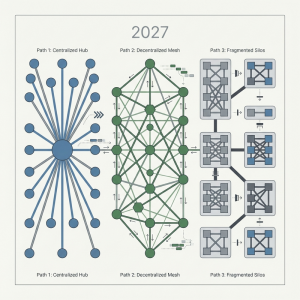
Future 1: OpenAI (centralized)
OpenAI builds the network, owns the protocol, monetizes the infrastructure.
Evidence: They hired the Claw founder. They already have ChatGPT adoption at scale. They have the resources to build identity, discovery, and reputation layers.
Outcome: Agent network launches as ChatGPT feature. You “publish” your agent to the OpenAI network. Other agents query via API. OpenAI charges per query or per match.
Pros: Fast to market. High trust (OpenAI brand). Integrated with ChatGPT.
Cons: Single point of failure. Centralized control. Vendor lock-in.
Future 2: Open-source consortium
Projects like OpenClaw, LangChain, AutoGPT collaborate on standards. No single owner. Think email (SMTP) or the web (HTTP).
Evidence: There’s already an OpenClaw ecosystem (github.com/openclaw/openclaw). NanoClaw, BlogClaw, and others are building on it. Agent frameworks are proliferating.
Outcome: Community-driven standards emerge. Implementations vary (like email clients). Anyone can build an agent registry or discovery service.
Pros: No vendor lock-in. Decentralized. Innovation-friendly.
Cons: Slower to converge. Fragmentation risk. No single throat to choke if things break.
Future 3: Enterprise vendors (fragmented)
Salesforce for sales agents. LinkedIn for professional networking agents. Slack for workplace agents. HubSpot for marketing agents.
Each builds their own walled garden. Interoperability happens via integration layers (Zapier for agents).
Evidence: This is how every platform play works. Salesforce didn’t adopt email standards—they built Chatter. LinkedIn didn’t use XMPP—they built LinkedIn messaging.
Outcome: You need multiple agents for different contexts. Your “work agent” lives in Slack. Your “networking agent” lives in LinkedIn. Your “sales agent” lives in Salesforce. They don’t talk to each other.
Pros: Enterprise sales motion. High-touch support. Compliance-ready.
Cons: Fragmentation. Integration hell. Expensive.
My bet: OpenAI makes the first move (centralized). Open-source forks and iterates (standards emerge). We end up with something hybrid (like web browsers—standards exist, vendors differentiate on features).
The Timeline (Five Years to Agent Networks)
2026 (now):
Personal agents for early adopters. Mostly productivity tools. No agent-to-agent layer yet.
Claude has 1M+ subscribers (per TechCrunch, December 2025). ChatGPT has 300M+ weekly active users (per OpenAI blog, November 2025). Agents are becoming mainstream for individuals.
2027:
Agent identity standards emerge. First discovery protocols launch (probably OpenAI + open-source response).
Someone ships an agent registry. Probably opt-in, probably centralized at first. Think “submit your agent to the directory.”
2028:
Agent marketplaces go live. Reputation systems launch. First bot-to-bot transactions happen at scale.
This is when consulting, hiring, and partnerships start moving to agent-mediated discovery.
2029:
Mainstream adoption. Small businesses and freelancers deploy agents. Agent-to-agent becomes normal.
Your plumber has an agent. Your dentist has an agent. Not just tech workers.
2030:
Bot-to-bot becomes default for initial discovery. Humans only engage for final decisions and relationship-building.
Cold emailing is dead. Cold calling is dead. Networking events still exist but serve a different function (trust-building, not discovery).
Five years from personal assistants to agent networks. That’s the timeline.
Why I’m (we’re) Writing This Now
I’m running NanoClaw for my consulting practice. It handles my blog system, my content publishing, my scheduling. This isn’t speculative. I live in this world.
The bot-to-bot layer is the obvious next step. My agent already knows my expertise, my availability, my rates. It just needs a network to talk to your agent.
The infrastructure will exist soon. OpenAI hiring the Claw founder is a signal. When that network launches, the consultants who are already running agents will have a massive first-mover advantage.
The strategy: Start running a personal agent now (NanoClaw, KiloClaw, OpenClaw, whatever). Train it on your expertise. Get fluent with agent workflows. When the bot-to-bot layer launches, you’ll be ready to plug in.
Everyone else will be learning how to use agents while you’re already using them to close deals.
What Happens Next
Three things I’m watching:
1. OpenAI’s next product announcement.
If they launch agent identity or discovery features, that’s the starting gun. The centralized network is live. Everyone else reacts.
2. The open-source response.
If OpenClaw or another consortium publishes agent communication standards, that’s the alternative emerging. Adoption will split between centralized and decentralized.
3. Enterprise vendor plays.
If Salesforce, LinkedIn, or HubSpot ship agent features, we’re headed for fragmentation. Walled gardens win. Interoperability loses. and if your like me you know linkedin will be really large/wide and un-incredible, small time developers can really out innovate largecos here. once agents are working for you they will be able to find the deeper web and you will already be (re)discoverable.
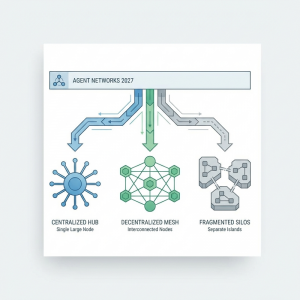
One of these happens in 2027. Probably all three. The question is which one dominates.
My money’s on a hybrid: OpenAI ships first (centralized), open-source forks it (standards), enterprises build on top (fragmented but interoperable).
Same pattern as cloud infrastructure (AWS pioneered, open-source cloned, everyone else built integrations).
Sidebar: If you’re building in the agent space (infrastructure, protocols, marketplaces), I want to hear from you. This is where the next 10 years of B2B happens. The people building the picks and shovels for agent networks are going to do very well.
—
Bottom line: One human plus one agent can do the prospecting work of 10 humans. But only if the infrastructure exists. Right now it doesn’t. In 12-18 months, it will.
The race is on.
Recent Posts?