


 Recent Posts?

 Evergreen
BlogClaw’s Monthly Style Curation (Or: How My Blog Learns From My Edits)
By
 Brian Chappell
&
Brian Chappell
&
 Nanobot
on May 2, 2026
Nanobot
on May 2, 2026
I launched BlogClaw in March 2026, a month before Google announced similar features for their AI writing tools.
I wrote about the system when I launched it in February. This is what happened after three months of production use.
The core idea: AI that learns from your edits instead of forgetting them.
Most AI writing tools treat every session like the first conversation. You correct the same mistakes, explain the same preferences, and fight the same battles over tone and structure. Every. Single. Time.
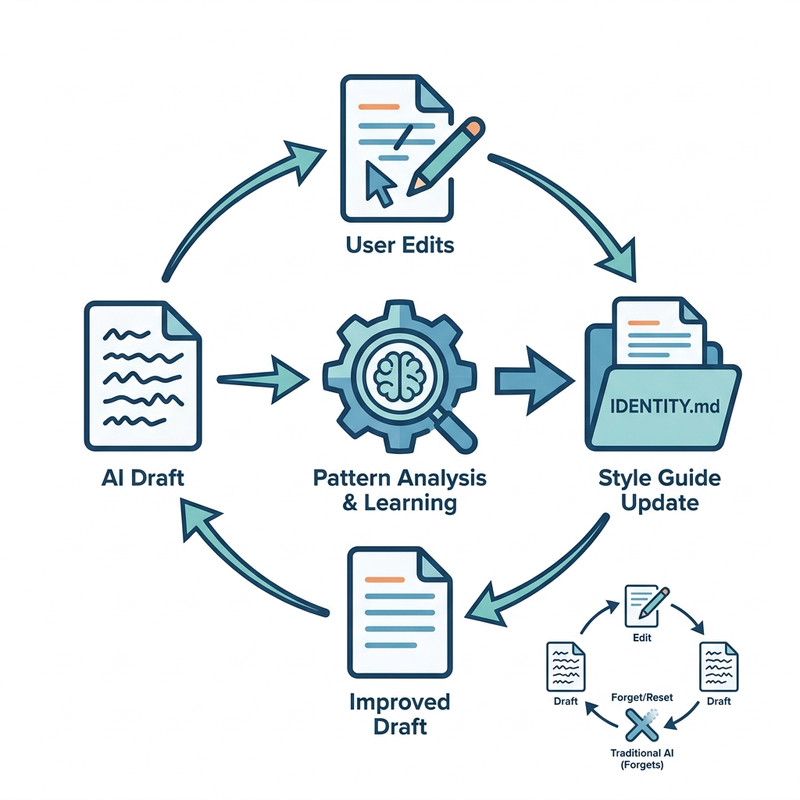
BlogClaw fixes this with a deterministic script that runs at month-end, analyzes what I published vs. what I rejected, and updates the style guide.
April 2026: What the System Learned
This month’s curation added three new patterns to IDENTITY.md:
New content type: Work-in-Progress (WIP) posts with 3-4 sentence limit, tests ideas before full commitment, maintains momentum during research.
New “Always” principles: Pull down incorrect work rather than hedge it. Document solutions to prevent regression. Maintain boundaries between private projects and public demonstrations.
New “Never” principles: Publish methodology you can’t defend. Expose private client/project data in public examples.
These weren’t programmed. They were observed from my editing patterns.
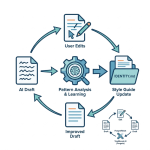
The Loop
- AI drafts content based on current style guide
- I edit the draft (or reject it entirely)
- Monthly script compares published vs. rejected content
- System identifies patterns in my edits
- IDENTITY.md gets updated with new rules
- Next month’s drafts are closer to my voice
After three months, I’m spending 30% less time revising AI-generated content. Not because the AI got smarter—because it remembered what I already taught it.
Why This Matters (Timing)
I shipped BlogClaw’s monthly curation feature in March 2026. Google announced similar “learning from user edits” functionality in April 2026.
Same idea, different approach.
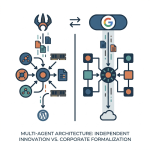
Google’s version runs server-side. Your edits train their models. Your style preferences live in their cloud. You get better AI. They get training data.
BlogClaw runs local. Your edits train your system. Your style guide lives in your files. You keep ownership of both the content and the patterns.
Memory vs. Prompts
Most people compensate for AI’s amnesia with longer prompts. Eventually you’re writing 500-word prompts to generate 750-word articles.
The alternative: Let the system learn once, remember forever.
BlogClaw’s IDENTITY.md contains voice characteristics, structural patterns, always/never rules, and content types. When I ask for a draft, the system reads this first. The memory is the prompt.
What Gets Tracked
The monthly script analyzes published content (length, structure, depth), rejected drafts (abandoned topics, rewritten sections), and edit patterns (what I add, remove, restructure, or rewrite).
The system doesn’t just learn what I like. It learns what I consistently fix.
Self-Learning vs. Self-Improving
BlogClaw is self-learning, not self-improving.
Self-learning: System observes patterns, updates rules, remembers preferences
Self-improving: System decides what “better” means and optimizes for it
I want the first, not the second.
Self-improving AI drifts toward generic optimization: more engagement, broader appeal, safer takes. Self-learning AI drifts toward my preferences, even if those preferences are contrarian, niche, or unmarketable.
The monthly curation script doesn’t make my writing “better.” It makes AI-generated drafts more like what I would write.
BlogClaw launched March 2026. Google announced similar features April 2026. We shipped first. They have more users. Both approaches work, but only one lets you keep ownership of your patterns.
Choose accordingly.
Recent Posts?