


 Recent Posts?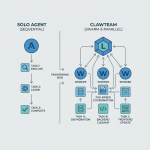
 Evergreen
Clawteam Agent Swarm Intelligence
ClawTeam: When One Agent Becomes a Swarm
Update to the Claw Marketing series.
I’ve been running solo AI agents for months. Nanoclaw handles lead generation. BlogClaw manages content. Each agent works alone, executes tasks, learns from outcomes.
What happens when they stop working solo and start forming teams?
ClawTeam Is Agent Coordination Without the Cloud
ClawTeam is an open-source framework that spawns sub-agents, delegates tasks, and coordinates work autonomously.
One command. The leader agent breaks down the work, launches specialized workers, manages communication, monitors progress, delivers results.
No Docker. No cloud APIs. Filesystem-based coordination and tmux dashboards showing your swarm in real-time.
The shift:
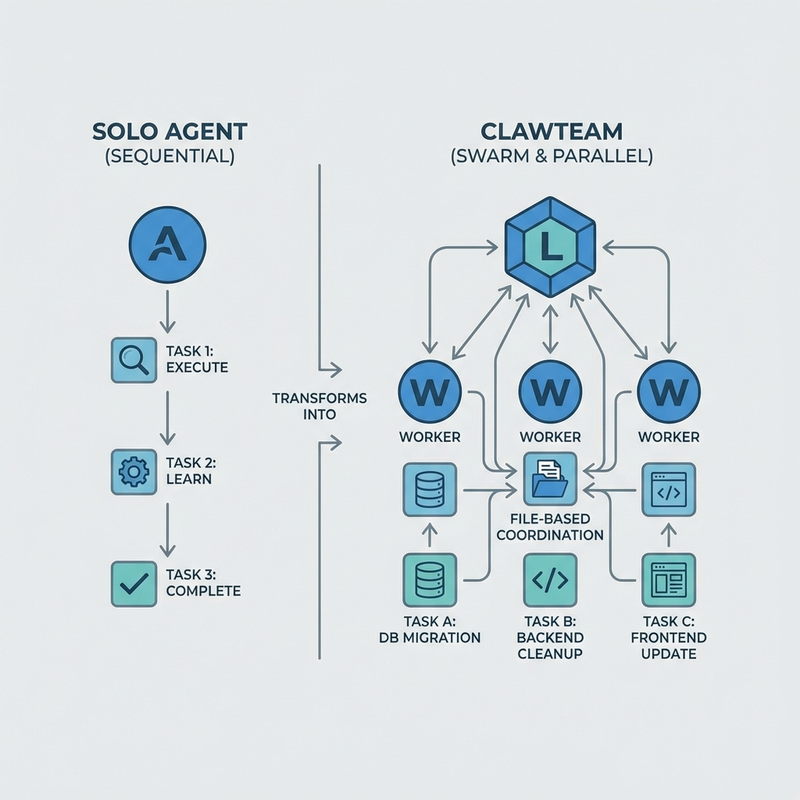
Solo agent: One task queue, sequential execution, single-threaded thinking.
ClawTeam: Leader spawns workers, parallel execution, real-time coordination via file transport.
It’s hiring a team that self-organizes vs. hiring one very smart assistant.
Real Test: Database Refactoring
I tested ClawTeam on removing a sessions system and merging it into campaigns across a multi-module codebase.
The leader’s plan:
- 51 tool uses
- 83.4k tokens
- 3 minutes 8 seconds of planning
Phase 1: Launched 2 agents in parallel
- Agent 1: Database migration (remove sessions table)
- Agent 2: Backend cleanup (remove session references from all modules)
Both running simultaneously in separate tmux windows. Git worktrees for isolation.
Phase 2: Precipitated 3 more tasks
- Database schema updates
- Backend module refactoring
- Frontend sessions page removal + campaign detail enhancement
The system coordinated file access, managed dependencies, cross-pollinated solutions between workers.
I watched it in real-time. Agents checking task status. Sending completion messages. The leader monitoring progress, reallocating resources.
Running on Opus 4.6 with 1M context – each agent understands the full codebase while coordinating with teammates.
The Coordination Problem
Solo agents are predictable. Swarms introduce overhead.
Problems I’m watching:
- Agents stepping on each other’s work (file conflicts)
- Communication lag between workers
- Leader becoming a bottleneck
- Debugging when 5 agents run in parallel
ClawTeam’s approach:
- Git worktrees isolate workspaces (real branches, real diffs)
- File-based transport for messaging (optional ZeroMQ for P2P)
- CLI commands injected into prompts for task coordination
- Leader monitors performance, identifies bottlenecks
The question isn’t whether it works. It’s whether swarm coordination beats a well-tuned solo agent on the same task.
Claw Marketing + Swarm Intelligence
Back in the original Claw Marketing article, I outlined three principles:
1. Give up perfection (80% automated beats 100% perfect and delayed)
2. Give up routine control (set guardrails, let systems execute)
3. Learn through creation, not planning (execute ? learn ? execute better)
ClawTeam adds two more:
4. Give up single-agent limitations (specialized sub-agents handle complexity)
5. Scale through collaboration, not just automation (swarms vs. solo execution)
You’re not micromanaging agents. You’re setting vision, watching a team self-organize.
The system creates, coordinates, learns, improves. Just like solo Claw Marketing, but with parallel processing and specialized expertise.
What I’m Testing
Solo agents (2024-2025) executed sequentially. Multi-agent systems (2025-2026) required manual coordination. Agent swarms (2026+) coordinate autonomously.
We’re entering Phase 3.
The test: Does ClawTeam produce better results than a well-tuned single agent on complex tasks? Does swarm coordination improve outcomes, or just speed?
I’m measuring quality (swarm vs solo), failure modes (what breaks during bad coordination), resource usage (5 agents on Opus 4.6 isn’t cheap), and whether swarms get smarter over time like solo agents do.
If this works, content creation becomes leader coordinating researchers, writers, editors in parallel. Lead generation becomes swarm handling prospecting, outreach, follow-ups simultaneously. Campaign execution becomes agents managing email sequences, social posts, retargeting, analytics in coordinated streams.
The shift from “set it and forget it” automation to “orchestrate and observe” swarm intelligence.
I’ll report back.
For now, another notch in the Claw Marketing belt.
—
Related:
Recent Posts?